The Best UK Student Accommodation for International Students ( The mys 2026 Guide)
21st Apr 2026

Moving to the UK for university is a big step, and for most international students, accommodation is the first real decision that carries some weight.
It’s not just about finding somewhere to sleep. You’re choosing where you’ll spend most of your time, how easily you’ll settle in, and whether your first few months feel manageable or unnecessarily stressful.
The challenge is that a lot of advice online either assumes you already understand the UK system, or throws too many options at you without context. What actually matters is simpler than that. If you’re booking from overseas, you’re usually balancing four things: how easy it is to arrange, how much it really costs, whether it’s safe, and whether you’ll feel comfortable living there.
Once you look at it that way, the choices become much clearer.
Purpose-built student accommodation
For most international students, this is the option that removes the most friction.
Purpose-built student accommodation — often shortened to PBSA — is designed specifically for students, and more importantly, for students who may not be physically in the UK yet. The booking process is usually fully online, contracts are relatively standardised, and the rooms are ready to move into without needing to organise furniture or utilities.
That level of simplicity makes a difference when you’re dealing with everything else involved in moving country.
Another reason it’s so popular is predictability. Rent is typically all-inclusive, which means you’re not trying to set up electricity accounts or split bills with strangers from another time zone. From a safety perspective, most buildings have controlled access and on-site staff, which adds a layer of reassurance when you’re new to the city.
It’s not the cheapest route, but for many students, the trade-off is worth it because it reduces uncertainty at a point where everything else already feels new.
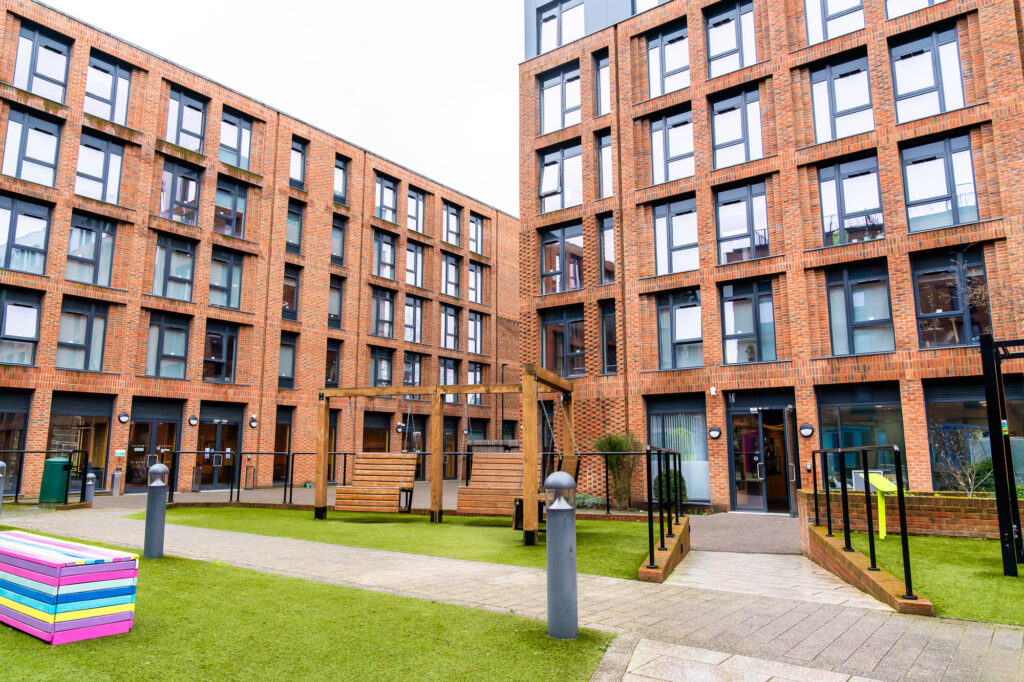
University halls of residence
If you’re in your first year, university halls are often the most straightforward option available.
They’re managed directly by the university, so the process tends to be clearly tied to your offer and enrolment. That alone makes things feel more structured, particularly if you’re unfamiliar with how renting works in the UK.
There’s also a social advantage that’s hard to replicate elsewhere. Everyone around you is new, and there’s a shared understanding that this is a transition period. For international students, that environment can make settling in noticeably easier.
In terms of safety and support, halls are generally one of the more secure choices. There are usually staff on hand, clear procedures, and less variation in standards compared to the private rental market.
They’re not always the most modern or spacious, but they do exactly what most first-year students need them to do: provide a reliable starting point.
Private student halls (higher-end options)
Private halls sit somewhere between PBSA and a more lifestyle-focused living experience.
In many ways, they offer the same convenience as standard purpose-built accommodation, but with added amenities and more attention to design and shared spaces. Gyms, study areas, and social lounges are common, and locations tend to be closer to city centres or major campuses.
For some students, that environment is part of the appeal. It’s easier to meet people, and the overall experience can feel more comfortable, especially if you’re used to a certain standard of living.
The main consideration is cost. These properties are usually at the higher end of the price range, so it becomes a question of how much you value the additional features versus keeping expenses down.
Shared student houses
This is where things start to feel more like “real” renting in the UK.
Shared houses — often referred to as HMOs — are typically the most affordable option, particularly outside London. You rent a room in a house or flat with other students, and share communal areas like the kitchen and living room.
The appeal is obvious: lower rent and more independence. But from an international perspective, it’s not always the easiest option to organise.
Unlike PBSA or halls, the process can be less standardised. You may need to deal with private landlords or letting agents, set up bills separately, and in some cases provide a UK-based guarantor. That can make things more complicated if you’re arranging everything from abroad.
Standards also vary more widely, so it’s important to be careful about what you’re committing to if you haven’t seen the property in person.
En-suite rooms
For students trying to find a balance between privacy and social living, en-suite rooms tend to be a practical middle ground.
You have your own bathroom, which removes one of the more common pain points of shared living, but you still share a kitchen and living space. That means you’re not completely isolated, but you also have a bit more personal space.
These are widely available in both university halls and purpose-built accommodation, so they’re relatively easy to arrange from overseas.
They’re not the cheapest option, but they often represent a reasonable compromise between cost, comfort, and social experience.

What to prioritise when booking from overseas
One of the biggest mistakes international students make is focusing too heavily on price without fully understanding how the system works.
Ease of booking should come first. If the process isn’t clearly set up for remote arrangements — for example, if you can’t view the property virtually or complete the contract online — it’s worth questioning whether it’s the right choice.
Clarity around pricing is just as important. In the UK, “rent” doesn’t always mean everything is included. Checking whether utilities, internet, and other costs are covered can prevent unexpected expenses later.
Safety is usually less of a concern than many students expect, but it still matters. Purpose-built accommodation and university halls tend to offer the most consistency in this area.
Finally, there’s the social aspect, which is often underestimated. Arriving in a new country without any immediate network can feel isolating, so living somewhere that naturally introduces you to other students can make a significant difference in how quickly you settle in.
So, what’s actually the best option?
There isn’t a single answer that works for everyone, but patterns do emerge.
For most international students booking from abroad, purpose-built student accommodation offers the easiest and most reliable experience. It removes a lot of the unknowns and simplifies the transition into UK life.
University halls are a close second, particularly for first-year students who want a more structured and supported environment.
If cost becomes the main priority, shared housing is usually the most affordable route, but it requires a bit more confidence navigating the rental process.
En-suite rooms tend to sit comfortably in the middle, offering a balance that works well for many students.
A final word before you book
The earlier you start, the more choice you’ll have. Good accommodation — especially in popular cities — doesn’t stay available for long.
It’s also worth taking the time to read contracts properly and ask questions if anything is unclear. Renting in the UK comes with certain expectations, and understanding them early can save a lot of stress later.
More than anything, the goal is to make your arrival as smooth as possible. If your accommodation is sorted, predictable, and suited to how you want to live, everything else becomes much easier to manage.